

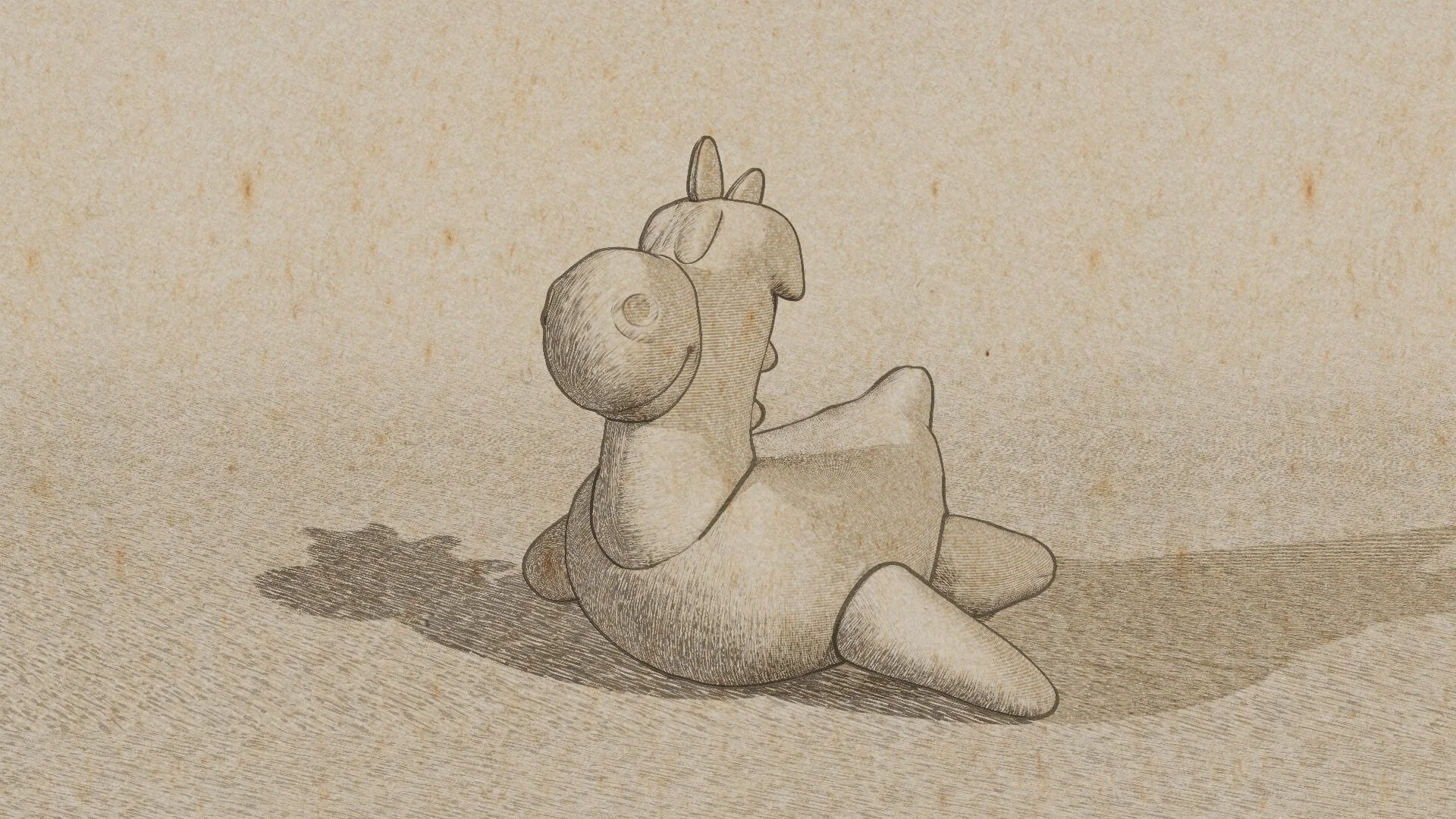
Sketching in Houdini
This style renders your artwork with a quick, minimalist pencil sketch. It features loose, expressive lines, likely with varying thicknesses, and minimal shading, emphasizing the essential form of the subject with a clean, uncluttered aesthetic.
TABLE OF CONTENTS
1. Scene Setup
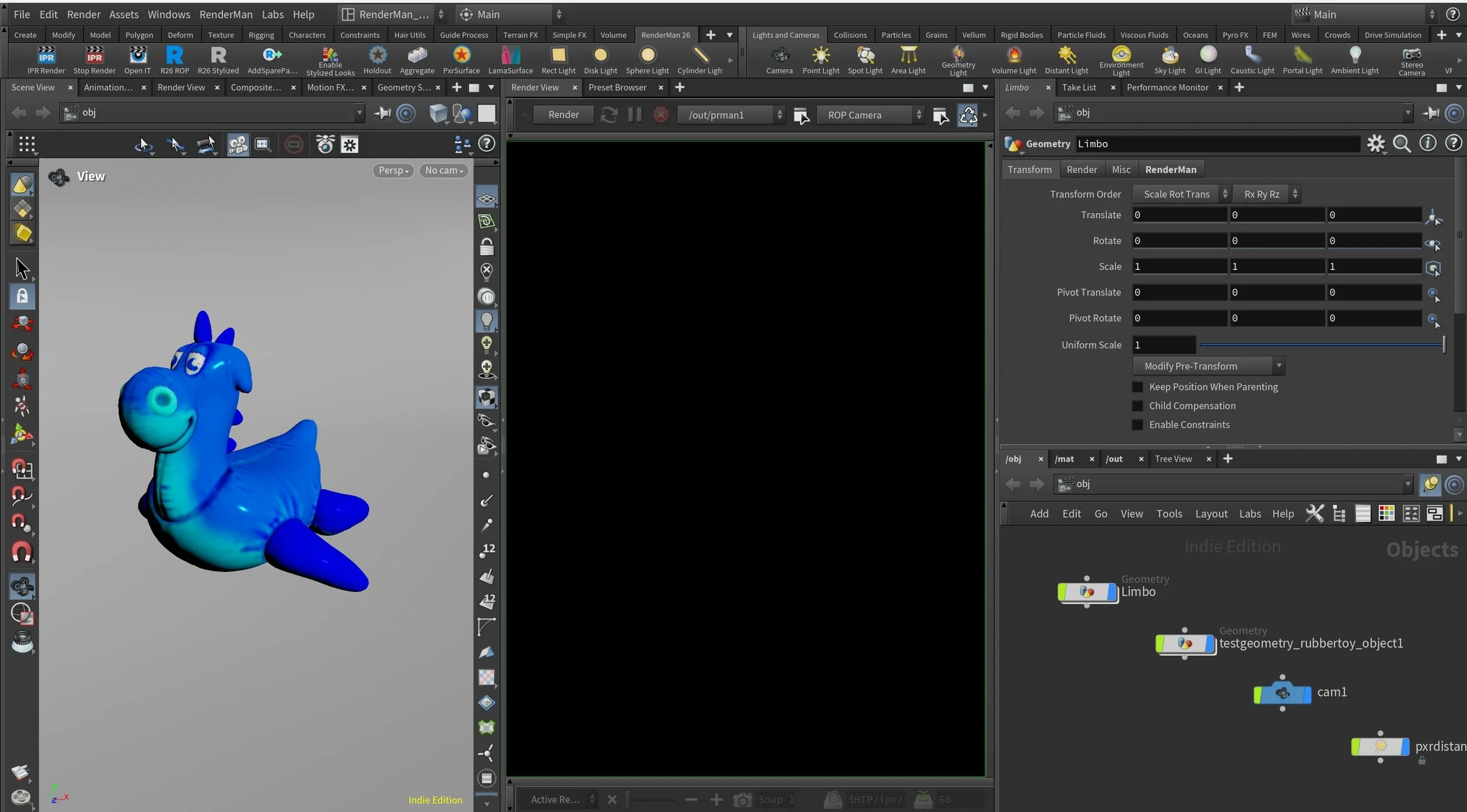
Most of the presets in this pack, if not all of them, require the presence of a UV map on all the objects. If you decide to use your own scene, you can do so as long as you take into account that without a UV map present on all the objects in your scene then the preset will not function as intended and you will have a visually unpleasing result.
This preset requires an additional light source to function properly. So go ahead and create another PxrDistantLight. Rotate the light to point to the left side of our view. You can move it for visual clarification as the image below.
The value of the light is not important, so keep the defaults.
The template.hiplc can be downloaded from the RenderMan Resources section. the Houdini project file include the template file along with all the completed projects for each brush type. We’re going to learn how to apply the preset to a brand new scene and then you can compare your results to the completed project.
Let us explore the template scene. It consists of two objects, A RubberToy and a Cyc (a.k.a Limbo). Both objects have UVs, see not below the image.
We also have one Distant light with a direction coming from the right side. There is a camera as well.
Both objects have their own PxrSurface materials. This will not matter once we import the preset because those materials will be replaced.
Alongside a distant light the scene is set with an RIS ROP with a PathTracer Integrator. The PathTracer Integrator Max Indirect Bounces is set to 0. Both of the choice of a Distant light and setting the Max Indirect Bounces to 0 are important for the look we are after but it is not a requirement for Stylized Looks. The importance is three folds.
I tend to use sharp shadow in all of my scenes so a Distant Light is the best choice to achieve that type of shadow.
I don’t want indirect light or additional light bounces to influence my lighting. All the direct and indirect lighting manipulation happens within the Stylized Looks framework, so no need for additional lights.
The combination of both a Distant light and Max indirect bounces results in the least amount of noise to sample through or even noise around the edges of the toon stepped shading. It is not as completely noise free as using the new Artistic Toon mode, but it is around 90% there while still being physically accurate.
Load the We’ll start by loading our template.hiplc file. Set your project directory to the presets project folder and load template.hiplc.
2. Import The Preset
Time to import the preset. Select the Toy object and open a RenderMan Preset View. Select the Sketching preset, right click and select Import and Assign to Selected
We’ll need to apply our preset on a single object. We’ll then make a copy of the material and apply that to the limbo object. The reason we do it only once is because the import preset mechanism in Houdini will import all the displayFilters for Stylized Looks. So if we import it twice then we’ll have two sets of each filter and that will cause the stylized looks to fail. There is currently no way to specify which parts of a Stylized Looks you want to import.
3. Apply Limbo Material
With the preset imported we are going to apply a second copy of our main material to the Limbo object.
You might be asking why do we need to copy the material on the limbo instead of creating a new one? or Why don’t we apply the same material of the toy object to the limbo? We’ll explore those questions and in the process we’ll learn a little bit on how Stylized Looks work and how shading networks setup work.
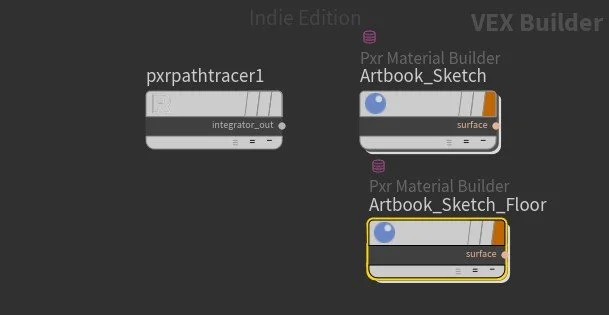
Why don’t we keep the current Limbo material or create a new one? The short answer to this is that for a material to function properly, really it is about having the displayFilters recognize the object and apply the Stylized Looks, then we need a certain setup added to the main surface of the object. By copying the material we have a starting point to go from with all the required material connection in place.
Stylized Looks doesn't mess with your original surface, so you can keep your existing shading networks. But to make it work, you need to add a PxrStylizedControl to the Utilities pattern of the surface. This won't break anything as the utilities pattern is like an auxiliary channel, and it lets you control the stylized look for each object separately. If you want to add more shading nodes to change the stylized look, do it on the PxrStylizedControl.
Why not use the same material as the one applied to the Toy object? The object UV size and object size determines the brush size. So we need separate values to tweak on an object by object level. Also, we sometimes we need different albedo color value for each object. This is way we give each object it’s own material.
For this preset the albedo or diffuse color is the same across all objects. However we need to tweak the PxrManifold2D that is connected to the PxrStylizedcontrol for the Limbo as well as change the Triplanar Scale values for the Limbo object. We’ll deal with those changes in step No.7.
4. ROP Setup
Up to this point we haven’t said much about the ROP setup and the rendering requirements. We’’re going to address that right now. If you are using the presets in this pack then this following step is going to be the same for all.
The template.hiplc file include an RIS ROP already setup. This ROP is configured to use a PathTracer as an integrator.
The PathTracer is configured to have 0 Max Indirect Bounces. This is important as it will be the equivalent to using PxrDirectLighting as an integrator, so our renders will be noise free, or minimal noise. But with a PathTracer we will have access to additional AOVs and LPEs which we don’t have access to in PxrDirectLighting.
However, when we import any Stylized Looks presets the preset browser will generate a new ROP for our scene. This ROP will have a direct connection to all the Stylized Looks displayFilters that make up the preset with the order they are intended to be used. So what I would do usually is to copy the path of our PathTracer integrator from the template ROP node to our new Preset ROP and delete the template one. So we end up with only a single ROP file in our project.
That is step 1 completed. We have a new ROP in our scene, it includes links to our displayFilters and it has our preconfigured PathTracer brought over.
Now for step 2. We must activate Stylized Looks in our ROP. This is not accomplished by pressing a single button, but require a collection of AOVs to be enabled. The list is quite long and it tends to take a minute or two to do. Instead of doing it by hand I have prepared a simple script that does that for you.
You can download the script from this github repo. Once downloaded, you can add it to any shelf as a button. I did mine inside of the RenderMan shelf, gave it the name “Enable Stylized Looks” and even gave it an icon.
For most of the presets these 4 steps is all that is required to hit that render button. This particular preset isn’t one of them, it needs only additional step, it’s not a complex one so bare with me. We’ll tackle that step next. But before we need to have a recap and see what we’ve done so far as the steps we’ve taken so far are the same for any of the presets in this pack.
RECAP
Before we move forward, let us recap what have we done so far, as these steps are pretty similar for all the presets in this pack. Any difference will be an additional light added to the template.hiplc projct and/or an additional AOVs that need to be present. For this preset we’ll need additional AOVs which we’ll do in the next step. But for all the presets the steps are as following:
Make sure you have a scene with UV maps
Have at least one PxrDistantLight as your main source light.
Apply the preset to your main object, or one object in the scene.
Make copies of the material and assign those copies to each object in your scene.
Copy the existing Pathtracer Integrator to the new preset ROP
Run the AOV script while selecting the prest ROP to create the default AOVs required by the Stylized Looks.
Can you use a PxrRectLight instead of a PxrDistantLight with Stylized Looks? You certainly can. And there is no rule that says you shouldn’t. But in my work, and this is a personal preference, I tend to use a PxrDistantLight because:
A it resolves faster. Meaning I don’t need many samples
I like my objects to have sharp shadows.
Works really well with a PathTracer Integrator with 0 Max Indirect Bounces. Again, less samples to work and much faster rendertimes.
5. LPE Setup
This presets requires additional AOVs to function, so we’ll add them now to our list of AOVs.
We need to add 4 additional AOV, we’ll be using LPE to create those.
Scroll down to the Custom section in the Extra Image Planes and create 4 custom AOVs by clicking the plus button 4 times.
Now next to the source of the first one, there is a drop down menu. Click it and:
Select Direct Diffuse for the first AOV
For the second one select Direct Specular.
And for the 3rd one Direct Diffuse.
Lastly, for the 4th one select Direct Specular.
This will add an expression in each of the source field. It will not populate the names of the AOVs though. So go ahead any name them as following:
directDiffuse_MAIN
directSpecular_MAIN
directDiffuse_EDGE
directSpecular_EDGE
Last step is to tell the LPE which light should the AOV account for. Currently it is accounting for both lights, and we want to change that to account for specific lights. So after the . at the L letter, add:
‘MAIN’ for first one
‘MAIN’ for the second one.
‘EDGE’ for the 3rd.
‘EDGE’ for the 4th.
6. Initial Render
Okay, that doesn't seem very appealing. Allow me to explain what is going on and how we can achieve the desired look. Before we dive into some core Stylized Looks hatching concepts, I suggest you get your favorite hot or cold beverage ready.
7. Tweaking Values
Ok! So that doesn’t look good. Let me explain what is happening here and how to resolve them. You’ll find that for almost all presets this will be the same one way or another. It might not be required in your scene, but in this scene the Limbo object UV scale is quite different than the Toy object so there is a noticeable difference.
There are many displayFilters in this presets. We can break them down to different categories based on their function in the styling process:
1x PxrStylizedToon filter to produce the desired toon stepping AOV. It will be used as a signal for specific hatching filters downstream.
5x PxrStylizedHatching filters produce, or describe the sketching brush look
2x PxrStylizedLines filters to produce the desired line-work
Right now we’re interested in 2 of the 3 main hatching filter. The hatching showing in the shadow area coming from our MAIN light, and the shadow hatching that is coming from our EDGE light. The EDGE hatching seams to be the worst on both object, currently it looks like a brick wall. The MAIN hatching (called Etch in the display filters) is ok on the Toy object, but requires tweaking on the Limbo. So let us deal with those.
1. Increase PxrManifold2D for Limbo:
I’ll start with the Limbo object for the MAIN Etch brush or hatching. Go into the material applied to the LIMBO object and find the PxrManifold2D node that is connected to the PxrStylizedControls node. There should be one in this preset, and it is usually connected to the Hatching Projection. So if you have more than one PxrManifold2D always check the one connected to the Hatching Project and this would be the one you want to tweak.
In the frequency S and T change the default of 20 to be 50 or 60. You can do a test render to see what effect that will have on our Limbo object. I went ahead with 60 for both S and T to match the Toy Object which I like the size of the etch streaks.
2. Increase Triplanar Scale for both objects:
The next we want to fix is the dashed hatch that currently looks like a brick wall. It is wrong on both objects so it would stand to reason to change it at the hatching filter instead on the object level. My issue there is that the Dashed filter is using 8 progressive values for each shading zone, so it will not be a quick change and it will certainly take long to resolve if we need to try different numbers.
Instead what I would normally do is get the base of the Triplanar Scale for both object into a similar frequency scale on the material level and then if I want to make a global change for all then I can be sure that that change will be identical across all materials
Why did we use PxrManifold2D for Etch hatching and we are using a different one for the Dashed lines? Stylized Looks offers several different methods for projecting hatch onto an object. Now would be a good time to discuss these projections method briefly.
I use 3 ones consistantly:
NPRtextureCoordinate AOV. I use this when I want my hatching brush to be laid out to follow the UV of my objects. This is where the PxrManifold2D is connected to. You can use any other node beside PxrManifold2D to drive it if you wish or your artwork requires.
Triplanar. I use this quite often for non uniform hatching projection and for additional effects.
Screen. This is the default projection method for PxrStylizedHatching display filter, and one that I use the least 😏 You’ll tend to find this hatching project added on top of all other hatching filter in my artwork. And I really use it as a screen filter basically that overlays the final rendered image.
For the dashed hatching I opted to use Triplanar projection because I didn’t to follow the UVs of the object specifically, so a Triplanar projection works well.
To tweak the values to the correct scale start by select the PxrStylizedControl for the Toy object and change the Triplanar Scale X, Y and Z in the Hatching projection category to be 5.
As for the Limbo object. Change those Triplanar Scale values to be 3.
Do a test render and see how much better the dashed lines look. You can tweak those to your liking and you don’t have to use the same values that I’ve used.
Congratulations!
You’ve made it through and you’ve done your first Stylized Looks render. 🎉
These steps might have seamed like a lot. And they are if you just started using Stylized Looks. As you gain more proficiency with Stylized Looks you’ll be able to set this up quiet quickly. And most of the presets aren’t that involved and will load out of the box, so instead of 7 steps they would be 4 steps. Tweaking the hatching values will always be required, so this long tour is necessary so you know how to get the most out of these presets and to learn how to tweak the stylized looks for your own project.
Preset perfection? Show your appreciation!

Back
